Rule, agent or human? How process mining and Lean Six Sigma find the steps worth giving to AI
Over the past year I have gone much deeper into applied AI, in a regulated enterprise and in a small company. When I looked back over the work of recent months, the same conclusion kept returning. I wrote this article to set it down and to summarise what I have learned so far.
In my view, the skill that will matter most is breaking a process down into steps an AI can perform, then giving the AI what it needs to do each step well. The first half is classic process work. The second half is where most AI projects are won or lost.
Many agent projects start with the agent. The process-improvement toolkit starts with the process: where volume is high, where work waits, where a rule decides and where a person has to judge. Those are the same questions that decide whether a step should go to an AI agent, to a simple workflow rule or stay with a person.
I come to this from 14+ years of enterprise business analysis and process transformation, using Six Sigma (Green Belt), Lean and DMAIC, and more recently process mining (Celonis Foundations, 2026). My offer is to combine that process discipline with applied AI: deciding which steps an AI should take, and setting each one up so the result can be trusted. The article maps the classic methods to what AI changes, shows how I sort steps into three classes, explains what an agent step needs, works through one example and compares process mining platforms with a well-written AI skill.
The classic toolkit and what AI changes
None of these methods is new. What changes is the time it takes to prepare the inputs, especially when the evidence sits in free text: tickets, emails, interview notes and SOPs.
| Method or tool | What it answers | What AI speeds up | What stays with the analyst |
|---|---|---|---|
| SIPOC, BPMN 2.0 process map | Scope, inputs, outputs, steps | A first draft from SOPs, interview notes and tickets | Checking the draft against how work really runs |
| Voice of the customer, CTQ tree | What users and customers care about | Clustering thousands of free-text comments into themes | Deciding which themes are critical to quality |
| Value stream mapping, the 8 wastes | Where time and effort go | Pulling waiting, handover and rework steps out of logs and descriptions | Measuring real lead times and agreeing the waste |
| Pareto analysis | Which few causes matter most | Classifying free-text records so a Pareto is possible at all | Defining the categories and checking a sample |
| Ishikawa diagram, 5 Whys, FMEA | Possible root causes and failure modes | A broad first list of hypotheses and failure modes | Testing each hypothesis with data; scoring severity with the team |
| Process mining: discovery, variants, conformance, throughput time | How the process really runs | Shaping the event log (case ID, activity, timestamp) and writing analysis code with open-source libraries such as pm4py | Checking that the log is complete and the result plausible |
| Cohort analysis | How segments behave over time | Running many cohort cuts quickly | Defining cohorts and KPIs |
| Control charts, control plan | Whether the improvement holds | Building the chart and drafting the control plan | Setting the reaction rules |
AI is fastest where the classic tools were slowed down by unstructured text and manual preparation. It is weakest where the method needs statistical proof or a decision. A correlation that an AI tool finds in a ticket log is a hypothesis. Lean Six Sigma practice, in line with the NIST AI Risk Management Framework, treats AI output as an input to a controlled decision, never as the decision itself. Research takes the same line: the PM-LLM-Benchmark tests language models on process mining tasks such as conformance checking and anomaly detection precisely because their answers still need checking.
From process data to agent candidates
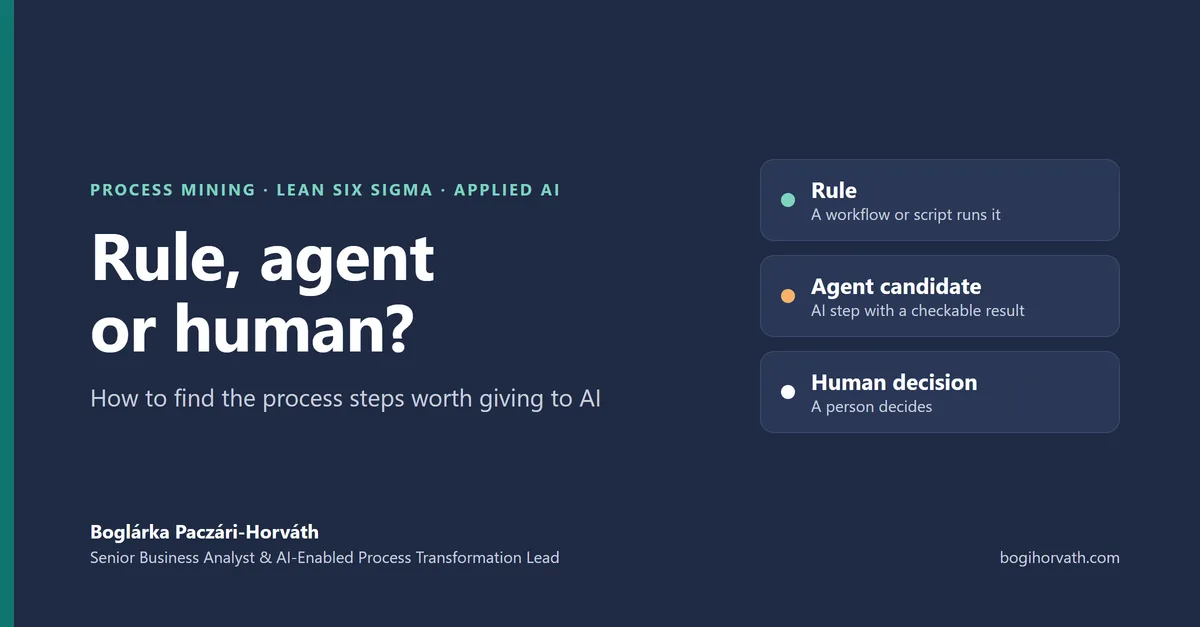
Once the process is mapped and measured, every step goes into one of three classes. The class also tells you how much freedom the AI gets.
- Deterministic rule. The step follows a documented rule on structured data, so a workflow, a script or RPA does it. The AI gets no freedom here: what can be calculated by code should be, because it is cheaper and more exact. An LLM adds cost and risk and nothing else.
- Agent candidate. The step needs judgement on unstructured input, such as reading a free-text description, comparing a document with a policy or drafting a reply, and the result can be checked. The AI gets a method (a rubric, examples, a fixed order of checks) and room to interpret within it.
- Human decision. The step is high-risk, irreversible or customer-facing in a way that needs accountability. An agent may prepare it, but a person decides.
The third class is not caution for its own sake. In a field experiment with 758 consultants at BCG, people using AI were 19 percentage points less likely to get a task right when it lay outside what the model could do. The study was co-funded by BCG and tested one such task, but in my view the lesson holds: knowing where the limit is matters more than prompting skill.
Process mining supplies most of the evidence for the classification. Volume and frequency show where automation pays off. The number of variants shows how standard the step is. Rework loops and exception rates show where the rules are unclear. Throughput and waiting times show where people are the bottleneck. What process mining cannot see is the content of free text, and that is where AI-assisted classification fills the gap.
To pick where to start, a simple score helps. Rate each agent candidate from 1 to 3 on five points: how often the step runs, how long it takes by hand, how repeatable it is, whether its input sits in one place, and how risky a wrong result is. A high total with low risk makes a good first pilot. A low total means the process needs fixing before any automation.
What an AI step needs
Sorting the steps is half the work. The other half is giving each agent step what it needs to perform well. A prompt alone rarely does that. The material around it matters more: examples of good output, the criteria that recur in them, your own working method, and only then the request. This is the four-part build known as 4P: example, priming, process, prompt.
Two habits keep this manageable. Keep that material in files, not in a long conversation: a crowded, mixed context makes the model confuse sources and err more often. And define the check and the approval point before the step runs, because an agent reporting that it is done is not evidence that it is. Each agent step gets a short card:
- Input and source of truth: where the data comes from, and which source prevails if two disagree.
- Method: the rubric, the examples and the order of checks.
- Output format: exactly what comes back, so the next step can use it.
- Check: who reviews which sample, and how often.
- Approval point: where a person signs off before anything reaches a customer.
- Owner: who updates the card when the process changes.
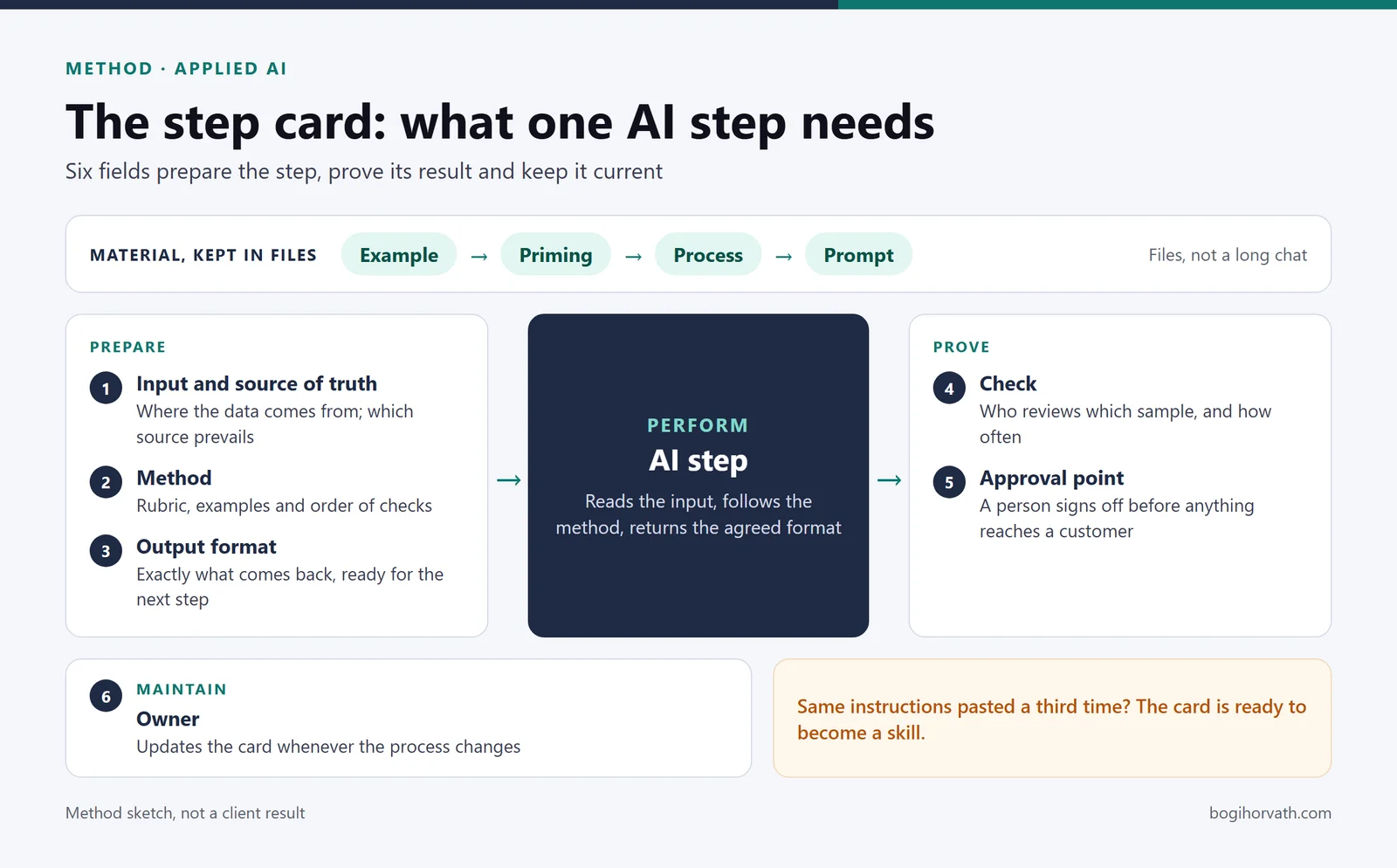
When the same instructions are pasted into a chat for the third time, the card is ready to become a skill.
Example: ticket quality checks at a telecoms company, rerun with today's tools
As Business Improvement Specialist at a large telecommunications company, I delivered USD 100k+ in annual savings (10 FTE) through automated ticket quality checks, and halved hung-line-check incident tickets. Generative AI was not yet part of the toolkit.
Today I would run the same analysis with an AI agent working in a project folder with connectors to the data, a small set of skills that hold my methods, and a person at every approval point. This is a method sketch, not a description of the original work. In a large enterprise, the agent would run inside the approved tenant, and the ticket data would not leave it.
- Prepare the project folder: the written quality criteria, a few tickets rated by an experienced person, and a brief with the question (where do tickets loop back for rework, and which quality defects cause it?). The agent gets read-only access to the ticket export.
- Build the event log. I define the case (the ticket), the activities (the status changes) and the timestamps. The agent writes and runs the analysis code, for example with the open-source pm4py library, and returns variants, rework loops and waiting times. I check that the log is complete and the results are plausible.
- Classify the ticket text with a skill that holds the rubric and the rated examples. The agent returns a Pareto of quality defects; a person reviews a sample of the classification before the chart is trusted.
- Sort each quality check into the three classes. A mandatory field or a valid code becomes a script. Judging whether a fault description is good enough for the next team is the agent candidate, with low-confidence cases routed to a person. Anything that changes what the customer is told remains a human decision.
- Pilot against the old process and track the defect rate on a control chart, using the baseline definitions. Once the same instructions are pasted a third time, the card becomes a skill file with a named owner.
The card for the agent candidate in step 4:
| Card field | Is this fault description good enough for the next team? |
|---|---|
| Input and source of truth | Read-only export of ticket text and fields; the written quality criteria prevail over individual habit |
| Method | Classification skill with the rubric, tickets rated by an experienced person as good and poor examples, and a fixed order of checks (rules first, judgement second) |
| Output format | Structured: verdict (good or needs rework), failed criterion, one-line reason, confidence level |
| Check | Weekly sample review by a person against their own rating; disagreements update the rubric and examples. The agent's "done" is not evidence |
| Approval point | Low-confidence cases go to a person; nothing that changes what the customer is told is sent automatically |
| Owner | The ticket-quality owner, who also owns the skill file and its review date |
Method sketch of how I would work today, not what was built at the time.
A process mining platform or a well-written AI skill?
Process mining platforms and AI skills solve overlapping problems in different ways. An AI skill, in the sense of Anthropic's open Agent Skills standard, is a folder with written instructions, scripts and reference files that an AI agent loads when a task matches. A good skill writes the method down once, for example a classification rubric or a DMAIC checklist, so the agent follows it the same way every time. The step card above is its raw material.
| Aspect | Process mining platform | Well-written AI skill |
|---|---|---|
| Strengths | Connects to ERP and ITSM systems at enterprise scale; object-centric data model; continuous KPI and conformance monitoring; governed platform with access control and audit trail; leading platforms now expose process data to AI agents | Fast and cheap to build and change; encodes the method, so every run follows the same steps; reads unstructured input such as SOPs, interview notes and ticket text; can run open-source process mining libraries on an exported log; fits small companies and short discovery sprints |
| Limits | Licence and implementation cost; the data model needs data engineering; longer time to first insight; its strength is structured system data | Not a system of record; no continuous monitoring unless someone builds it; results can vary between runs and need review; scale is limited by exports and compute; in an enterprise it must run inside approved tooling |
| Best use | Continuous, large-scale measurement of structured processes in an enterprise | Applying a method quickly, handling text and turning analysis into a classified step list |
In my view this is not an either-or choice. The leading platforms now open their process data to AI agents; Celonis, for example, publishes a Model Context Protocol server. An AI agent with a well-written skill can therefore query process intelligence directly: the platform supplies measured facts, the skill supplies the method. In a large enterprise that combination makes sense, inside the approved tooling. A small company or a two-week discovery sprint can often start with an exported log and a skill, and decide later whether the volume justifies a platform.
SAP-centred enterprises have a parallel route: SAP brought its Joule assistant into the Signavio suite (generally available since February 2026), with agents for process analysis, some of them still in beta. Whichever platform supplies the process facts, deciding which step becomes a rule, an agent or a human decision still takes a method, and giving the agent step what it needs still takes a person who understands the process.
Which step an AI should take is a process question before it is an AI question. If you have classified steps for automation, which criterion turned out to matter most?
Sources
- Dell'Acqua, F. et al. (2026). Navigating the Jagged Technological Frontier. Organization Science 37(2). hbs.edu
- Celonis, Process Intelligence MCP Server: developer.celonis.com
- Agent Skills, an open standard: agentskills.io; Anthropic
- PM-LLM-Benchmark (Berti): github.com/fit-alessandro-berti/pm-llm-benchmark
- SAP, Joule in SAP Signavio (generally available February 2026): news.sap.com
- NIST AI Risk Management Framework: nist.gov
Want the full playbook behind this?
14+ years of results, EUR 1.1M+ documented savings. Senior Business Analyst & AI-Enabled Process Transformation Lead. 2 pages, no signup.